Low-pressure hydraulic and fluid transfer systems often become an afterthought during initial design. Engineers frequently focus entirely on high-pressure mainlines. This common oversight routinely leads to premature component failures. It causes messy fluid leaks and expensive operational downtime. We cannot afford to ignore these critical utility lines in modern industry. Enter the purpose-built LEAD-FLEX SAE100 R6 Hose. It stands as a rigorously compliance-tested solution. It perfectly fits environments demanding continuous flexibility and high vibration resistance. The robust chemical compatibility ensures long-term reliability. Our objective in this guide is straightforward. We want to provide engineers and procurement specialists a transparent, data-backed framework. You will learn how to accurately evaluate and specify this hose. You can implement this reliable solution across demanding industrial applications to keep your operations running seamlessly.
Key Takeaways
Business Value: Minimizes system downtime and maintenance costs through high abrasion resistance and a "no-skiving-required" design that accelerates assembly.
Engineering Foundation: Built with a highly oil-resistant NBR inner tube and a single textile braided reinforcement for maximum flexibility in tight routing spaces.
Verified Compliance: Strictly adheres to SAE J517 standards, ensuring reliable performance in temperature ranges from -40°C to +100°C.
Broad Compatibility: Engineered for petroleum-based hydraulic fluids, mineral oils, lubricating oils, antifreeze, and low-pressure water/air lines.
The Hidden Costs of Low-Pressure Failures: Why Hose Selection Matters
Equipment downtime drains industrial budgets at an alarming rate. Substandard low-pressure hoses burst unexpectedly. You immediately pay for emergency repair labor. You also face costly environmental cleanup if hazardous fluids spill. Lost production time hurts your bottom line even more. Business leaders often underestimate these compounding financial impacts. A simple ruptured line can halt a multi-million-dollar assembly process.
Industrial settings represent incredibly harsh operating environments. Hoses endure continuous mechanical vibration from heavy machinery. They experience constant abrasive friction against rough metal machine chassis. They also face daily exposure to ozone and severe UV degradation outdoors. These environmental stressors rapidly destroy standard commercial rubber tubing. You must select materials engineered specifically for these hostile conditions.
Procurement teams frequently face a difficult sourcing dilemma. Buyers often fall into two distinct traps. First, they over-specify their requirements. They waste valuable budget on expensive, high-pressure wire-braided hoses for simple return lines. Alternatively, they severely under-specify the components. They choose cheap, non-compliant rubber tubing to save money upfront. This cheap tubing quickly ruptures under sudden system pressure spikes. Balancing cost and capability requires standardized, application-specific solutions.
Deconstructing the LEAD-FLEX SAE100 R6 Hose: Engineered for Longevity
Let us deconstruct the physical layers of this engineered product. The inner tube utilizes high-grade NBR (Nitrile Butadiene Rubber). It serves as your primary chemical defense mechanism. NBR resists chemical degradation brilliantly over long periods. It easily handles exposure to glycol, hydrocarbons, and standard hydraulic fluids. This inner core prevents swelling and maintains structural integrity inside the line.
The reinforcement layer uses a single textile fiber braid. We must contrast this textile braiding against traditional wire braiding. Wire braid adds unnecessary weight and rigidity to low-pressure systems. The fiber structure provides ample pressure retention safely. It handles up to 400 PSI (2.1 to 3.4 MPa) without issue. Furthermore, textile reinforcement keeps the entire assembly highly flexible. It significantly reduces the overall weight per meter.
The outer cover consists of weather-resistant synthetic rubber. This protective layer plays a crucial role in daily operations. It resists external abrasion from rubbing against vibrating machine parts. It prevents accidental cuts from sharp debris in the workspace. The synthetic compound also fights off premature aging and harsh weather conditions. This engineered outer shell ultimately extends the total service life of your assembly.
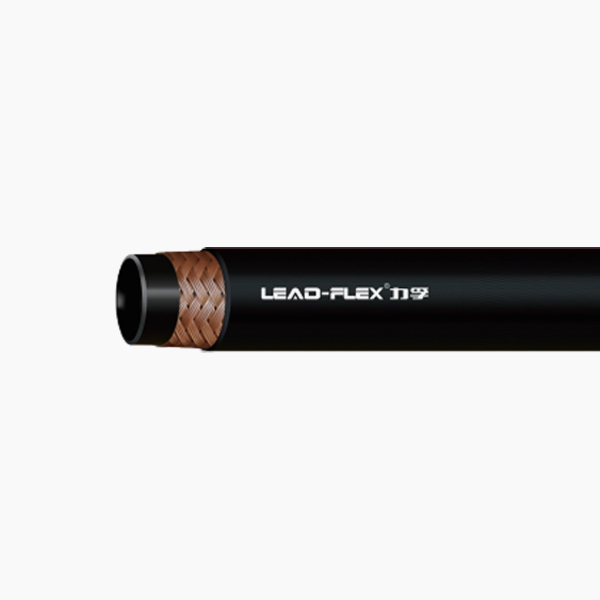
Standardized compliance forms the bedrock of industrial safety. The SAE J517 Type 100R6 standard acts as a critical baseline. It ensures strict quality assurance and uniform manufacturing tolerances. You must demand compliance when specifying fluid transfer components. This standard guarantees the hose will perform predictably under stated conditions.
You must carefully verify all stated operating parameters. The LEAD-FLEX SAE100 R6 Hose features a broad temperature threshold. It functions reliably from -40°C up to +100°C. You must also understand the crucial ratio between Working Pressure (W.P) and Minimum Burst Pressure (B.P). A standard 4:1 safety factor generally applies here. This ratio prevents catastrophic failure during unexpected pressure surges.
Dimensional flexibility matters deeply in modern machine design. We emphasize the minimum bending radius metric during engineering reviews. Smaller internal diameters (IDs ranging from 3/16" to 3/4") offer incredible routing flexibility. They allow engineers to route lines through highly constrained machine compartments. The textile braid prevents kinking or flow restriction in these tight spaces.
Hose Inner Diameter (ID) | Max Working Pressure (MPa) | Min Burst Pressure (MPa) | Temperature Range |
3/16" (4.8 mm) | 3.4 | 13.8 | -40°C to +100°C |
1/4" (6.4 mm) | 2.8 | 11.0 | -40°C to +100°C |
3/8" (9.5 mm) | 2.8 | 11.0 | -40°C to +100°C |
1/2" (12.7 mm) | 2.8 | 11.0 | -40°C to +100°C |
3/4" (19.0 mm) | 2.1 | 8.3 | -40°C to +100°C |
Agricultural and construction equipment operate in brutal outdoor environments. Tractors and earthmovers face constant, aggressive chassis vibration daily. Dirt and debris constantly abrade exposed fluid transfer lines. You need components capable of absorbing this continuous movement. The textile braid design absorbs these mechanical shocks effortlessly. It bends rapidly without fatiguing the inner rubber tube. Rigid wire-braided lines often fail here because they become too stiff. Our textile solution routes seamlessly around tight tractor attachments.
Modern automotive systems require strict fluid compatibility and extreme reliability. Low-pressure circuits perform critical functions inside vehicles. Power steering return lines rely on steady, unrestricted fluid flow. Specific braking circuits need reliable pressure retention to ensure passenger safety. You cannot risk fluid contamination in these systems. NBR rubber prevents chemical breakdown entirely. Petroleum-based fluids flow smoothly without degrading the inner tube. This material reliability keeps automotive systems functioning safely.
Industrial manufacturing lines rely heavily on versatile utility lines. Factories need dependable methods for conveying general-purpose air and water. Lubricating oils must travel seamlessly across busy factory floors. The LEAD-FLEX SAE100 R6 Hose serves as the perfect universal utility line. Maintenance teams keep bulk reels on hand for rapid deployment. It simplifies inventory management by replacing multiple inferior hose types. One standardized roll covers diverse low-pressure facility needs.
Comparison Chart: Textile Braid vs. Wire Braid in Low-Pressure Use
Feature | Textile Braid (SAE100 R6) | Wire Braid (SAE100 R1/R2) |
Flexibility | Excellent; easily routes tight corners. | Rigid; resists tight bending radii. |
Weight | Lightweight; reduces assembly drag. | Heavy; adds stress to fittings. |
Vibration Resistance | Superior; absorbs constant movement. | Moderate; wire can fatigue over time. |
Cost Efficiency | High for low-pressure applications. | Poor if used for low-pressure lines. |
Implementation Realities: Assembly, Routing, and Risk Mitigation
Assembly speed matters greatly during field repairs. We highlight the valuable "no skiving required" feature here. Skiving means removing the outer rubber cover before attaching a fitting. Skipping this cover-removal step provides a massive assembly advantage. It lowers mechanical friction during the insertion process. It also drastically reduces human error during crimping procedures. Your maintenance technicians will complete field repairs much faster.
Routing best practices prevent premature failures in the field. Engineers must provide actionable advice to installation crews. First, avoid torsional twist at all costs during installation. Twisting tears the internal reinforcement fibers apart. Second, respect the specified minimum bend radius strictly. Bending too tightly causes material fatigue and eventual rupture. Finally, use proper clamps to secure loose lines. Clamping prevents the cover from rubbing against vibrating metal edges.
Actionable Routing Guidelines
Measure Twice: Always cut the hose slightly longer than the exact distance to allow for pressure expansion.
Align Fittings: Ensure fittings align naturally with the connection ports to avoid forcing a torsional twist.
Utilize Adapters: Use angled adapters (like 45° or 90° elbows) to avoid bending the hose sharply at the connection point.
Isolate Heat: Route lines away from exhaust manifolds or utilize protective heat sleeves if proximity is unavoidable.
Maintenance and inspection protocols keep your facility safe. We recommend establishing a realistic, recurring inspection schedule. Do not wait for a catastrophic fluid blowout. Watch closely for early warning signs of impending failure. Look for cover blistering, which indicates incompatible fluids penetrating the tube. Check for localized abrasion spots where the rubber has worn down. Replace any compromised sections immediately before they burst.
Procurement Logic: Shortlisting and Specifying Your Hydraulic Hoses
Vendor evaluation criteria must extend far beyond simple unit prices. Cheap hoses often cost you more in the long run. Advise buyers to look for factory-direct OEM capabilities. A direct manufacturer provides better quality control and faster scaling. Demand verifiable dimensional tolerance charts before signing any purchase orders. Check their lifetime guarantee policies or warranty terms carefully. Reliable suppliers stand firmly behind their manufacturing processes.
Specifying the correct components requires detailed technical communication. Buyers must gather specific information before requesting an accurate quote. You need to define the exact Inner Diameter (ID) and Outer Diameter (OD) requirements. You should specify desired bulk reel lengths, such as standard 250ft rolls. Clearly define the intended fluid media the line will carry. This transparency helps the manufacturer confirm chemical compatibility immediately.
Checklist for Requesting Quotes
Provide exact required ID and OD measurements.
State the maximum working pressure of your specific system.
List all fluids or gases the line will transport.
Note the maximum and minimum ambient operating temperatures.
Specify requested lengths (e.g., custom cut assemblies or bulk reels).
Conclusion
Choosing a correctly specified, textile-reinforced hose provides a massive strategic advantage. It permanently solves the unique challenges found in low-pressure environments. You eliminate the wasted budget spent on over-engineered wire-braided lines. You also prevent the catastrophic failures caused by cheap, unreinforced rubber tubing. Correct specification keeps your machinery running and your floors clean.
We reiterate that the LEAD-FLEX SAE100 R6 Hose bridges a critical engineering gap. It perfectly balances extreme mechanical flexibility with true industrial-grade durability. It absorbs vibration, resists harsh chemicals, and accelerates field assembly. This hose represents the definitive standard for low-pressure fluid routing.
Do not leave your critical utility lines to chance. We encourage engineers and procurement managers to act today. Request a detailed technical specification sheet for your records. Connect directly with our technical support team to discuss custom OEM requirements. Secure the reliable components your demanding industrial applications deserve.
FAQ
Q: What fluids are compatible with the LEAD-FLEX SAE100 R6 Hose?
A: This hose expertly handles petroleum-based oils, mineral oils, lubricating fluids, water, and standard antifreeze. The NBR inner tube resists degradation from these common mediums. However, you must exclude highly aggressive chemicals, strong acids, and specialized aviation fuels to prevent internal damage.
Q: Does this hose require skiving before attaching fittings?
A: No. The single textile braid design typically allows for a quick, no-skive assembly. You can attach fittings directly over the cover. This advantage saves significant time, reduces assembly friction, and eliminates the need for specialized skiving equipment during field repairs.
Q: Can the SAE100 R6 be used for high-pressure hydraulic applications?
A: No. We strictly designate this product for low-pressure lines, typically maxing out around 400 PSI depending on the diameter. For high-pressure needs, you must steer toward R1 or R2 wire-braided hoses designed specifically to contain extreme fluid forces.
Q: What sizes are commonly available for field implementation?
A: We provide standard internal diameter availability ranging from 1/4 inch to 3/4 inch. These sizes cover the vast majority of low-pressure utility routing needs. We can also supply larger sizes depending on custom reel orders and specific OEM manufacturing requests.
Q: Is this hose suitable for outdoor and exposed environments?
A: Yes. The synthetic rubber outer cover provides excellent weather resistance. It actively resists ozone degradation, harmful UV rays, and general aging. This makes it highly capable of surviving exposed, outdoor environments on construction and agricultural equipment.


