Modern medium-pressure hydraulic systems rely heavily on standard single-wire braid hoses. They balance essential pressure retention and crucial routing flexibility perfectly. Engineers frequently face a tough specification challenge in the field. You must specify hydraulic lines for tight-clearance equipment carefully. Over-specifying heavy, multi-wire alternatives wastes budget and adds useless weight. Conversely, under-specifying causes premature failures, equipment downtime, and hazardous leaks. You need a reliable middle ground to keep operations running smoothly.
This article delivers an objective, specification-driven evaluation framework for your engineering team. We will guide you through selecting, routing, and validating single-wire hoses for enterprise and industrial procurement. You will learn how to match dimensional tolerances effectively. We will also show you how to verify impulse testing data and ensure leak-free assembly in demanding environments.
Key Takeaways
Standard Equivalency: SAE 100R1AT and EN 853 1SN represent aligned global standards for single-wire braid hoses, featuring a "no-skive" outer cover for faster assembly.
Operating Envelope: Optimized for medium-pressure applications, typically supporting -40°C to +100°C (-40°F to 212°F) environments and compatible with petroleum- and water-based hydraulic fluids.
Quality Indicators: Reliable procurement requires verifying impulse testing data (minimum 150,000 cycles) and exact dimensional tolerances to ensure leak-free crimping.
Application Fit: Ideal for agricultural machinery, mobile construction equipment, and manufacturing lines where extreme high pressure (like 2SN/4SP requires) is not the primary constraint.
Decoding the Standards: SAE 100R1AT vs. EN 853 1SN
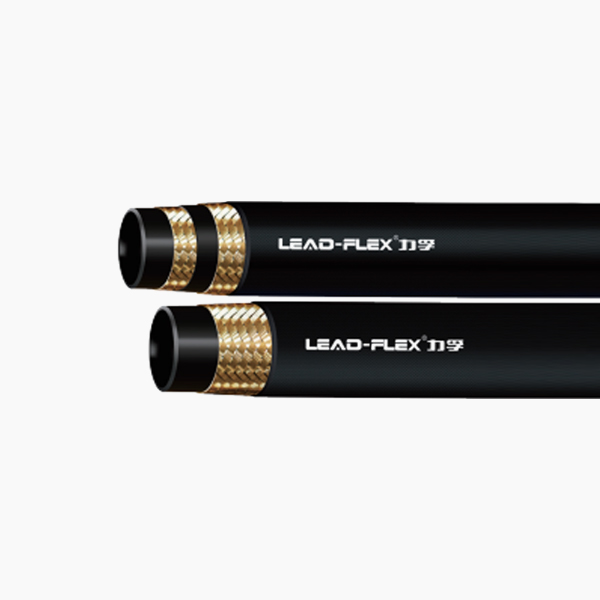
Global regulatory bodies created separate hydraulic standards decades ago. The Society of Automotive Engineers (SAE) developed benchmarks for North America. European organizations utilized EN and DIN specifications. Today, modern manufacturing has functionally merged these distinct origins. When you source a SAE100R1AT / EN853 1SN Steel Wire Braided Hose, you receive a product meeting dual-certification requirements.
The "AT" and "1SN" designations highlight a specific design advantage. Both codes indicate a thin-cover outer profile. This profile enables "no-skive" fitting assembly on the shop floor. Technicians do not need to strip the outer rubber layer before crimping the fitting. This implementation reality reduces manual labor time significantly. It also lowers the inherent risk of damaging the internal wire braid during preparation.
Compliance baselines dictate strict manufacturing tolerances. These standards mandate minimum dimensional exactness for inner diameters and outer diameters. They also enforce rigorous burst pressure and structural testing. Manufacturers must prove their hoses withstand extreme volumetric expansion limits. Meeting these baselines ensures safe fluid transfer across diverse mobile and stationary industrial applications.
Quality hydraulic hoses rely on precise structural engineering. The inner tube uses seamless, oil-resistant synthetic rubber. Manufacturers typically utilize Nitrile Butadiene Rubber (NBR) for this layer. NBR prevents aggressive fluid permeation effectively. It resists chemical degradation when exposed to synthetic hydraulic oils. A well-extruded inner tube maintains system cleanliness and prevents internal contamination.
The reinforcement layer provides the required structural integrity. It consists of a single layer of high-tensile steel wire braid. The specific wire tension and braiding angle determine overall hose flexibility. These variables control the minimum bend radius directly. An optimized braid angle also extends the overall impulse life. It prevents wires from rubbing against each other aggressively under pulsating pressure.
Outer cover durability protects the internal reinforcement. Manufacturers formulate this synthetic rubber cover carefully. It must resist external abrasion from moving machinery parts. It also fights environmental degradation from ozone, UV exposure, and minor chemical spills. A robust cover prevents moisture from reaching the steel wire, which stops localized rust.
Pressure dynamics scale inversely regarding the inner diameter (I.D.). Smaller hoses handle much higher Working Pressures (WP) and Burst Pressures (BP). Larger hoses naturally offer lower pressure thresholds. Buyers must always reference exact manufacturer tables for specific dash sizes.
Dash Size | Inner Diameter (Inch) | Working Pressure (PSI) | Burst Pressure (PSI) | Min. Bend Radius (mm) |
-04 | 1/4" | 3,270 | 13,080 | 100 |
-06 | 3/8" | 2,610 | 10,440 | 130 |
-08 | 1/2" | 2,320 | 9,280 | 180 |
-12 | 3/4" | 1,530 | 6,120 | 240 |
-16 | 1" | 1,280 | 5,120 | 300 |
Fluid Compatibility and Thermal Limitations
Verifying media compatibility prevents catastrophic system failures. The inner NBR tube handles a wide variety of industrial fluids safely. You should strictly use approved media to maintain warranty validity and operational safety.
Petroleum-based hydraulic oils: Standard mineral oils used in mobile equipment.
Water-glycol emulsions: Fire-resistant fluids required in specific manufacturing environments.
Lubricating oils: Standard machine lubricants and heavy gear oils.
Aqueous emulsions: Water-oil mixtures used in specialized cooling circuits.
Temperature thresholds require strict attention during system design. The standard operating range spans from -40°C to +100°C. However, implementation risks rise at absolute maximum temperatures. Continuous operation at +100°C accelerates rubber hardening significantly. Hardened rubber loses its flexibility and cracks under dynamic pressure.
Different fluids enforce specific thermal limits. While oil operates safely near +100°C, other media act differently. Air and water applications typically cap at +70°C or +85°C. Hot water degrades synthetic rubber faster than hot oil. You must consult specific fluid data sheets before deploying these hoses in extreme environments. Operating safely within thermal limits extends overall service life exponentially.
Vendor Evaluation Framework: Identifying High-Quality 1SN Hoses
Procuring a high-quality SAE100R1AT / EN853 1SN Steel Wire Braided Hose demands rigorous supplier vetting. You cannot rely on visual inspections alone. Industrial buyers should implement a strict evaluation framework.
Demand Impulse Testing Data: A trustworthy manufacturer must provide certified testing data. This data proves the hose survives standard hydraulic impulse cycles. Single-wire hoses require a minimum of 150,000 continuous cycles without weeping or bursting. Testing under pulsating pressure mimics actual field conditions accurately.
Analyze Concentricity and Extrusion: Uniform wall thickness remains absolutely critical. You should measure the rubber thickness around the entire circumference. Uneven rubber extrusion leads to skewed crimping outcomes. This inconsistency creates micro-leaks under peak operating pressure. Symmetrical extrusion guarantees a perfect seal between the fitting and the hose.
Verify Braid Integrity: Poor wire quality ruins hose stability. Loose braiding causes hoses to elongate or contract excessively when pressurized. The industry standard rule dictates specific limits. Length change under maximum working pressure must remain within +2% to -4%. Excessive movement rips fittings from mounting brackets and causes severe equipment damage.
You should request factory audit reports routinely. Reputable vendors use laser micrometers to measure dimensional tolerances continuously during production. They reject out-of-spec batches before vulcanization. Identifying these rigorous quality control steps protects your supply chain.
Sizing, Routing, and Installation Realities
Calculating the minimum bend radius prevents immediate structural damage. Every specification sheet lists a precise minimum bend value. Routing a hose tighter than this limit compromises the wire braid instantly. The steel wires flatten and pinch the inner tube. This restriction creates turbulent fluid flow and localized heat buildup. It also increases the risk of a blowout on the outer curve.
Avoiding torsional stress requires careful installation techniques. Evidence-oriented studies show severe penalties for twisting. Twisting a hose even 5 degrees can reduce its service life by up to 70%. When installing lines on moving boom arms, keep the bending motion in a single plane. Technicians must use two wrenches during assembly. One wrench holds the hose fitting steady, while the other tightens the mating connection.
Fitting compatibility ensures system safety and prevents catastrophic blowouts. You must use matched, manufacturer-approved fittings exclusively. Standard 1-piece or 2-piece no-skive fittings match the hose dimensions perfectly. Mixing different brands of hoses and fittings voids safety ratings immediately. The crimp specifications rely on specific shell designs and exact compression diameters. Always use the crimp chart provided by the specific hose manufacturer.
Shortlisting Logic: When to Choose 1SN over 2SN or 100R17
Engineering teams frequently compare single-wire hoses against heavier alternatives. Choosing 1SN over 2SN (SAE 100R2) provides distinct advantages. You should select 1SN for its lighter weight and superior routing flexibility. It costs significantly less than two-wire options. Use it confidently when your system operating pressures do not demand a dual-braid design.
Comparing 1SN against SAE 100R17 requires understanding pressure dynamics. The R17 standard features a constant working pressure across all dash sizes. It maintains 3000 PSI capacity whether you use a 1/4-inch or a 1-inch line. It also offers a tighter bend radius. Conversely, the 1SN pressure drops as the internal diameter increases. 1SN remains the better choice for high-volume, low-pressure return lines or auxiliary circuits.
Comparison Matrix | SAE 100R1AT / 1SN | SAE 100R2AT / 2SN | SAE 100R17 |
Wire Reinforcement | 1-Wire Braid | 2-Wire Braid | 1 or 2-Wire (Depends on size) |
Working Pressure | Variable (Decreases with size) | Variable (Higher than 1SN) | Constant (3000 PSI across sizes) |
Flexibility / Bend Radius | High / Standard | Medium / Standard | High / Compact |
Weight & Cost | Low Weight / Cost-Effective | Heavy / Higher Cost | Medium Weight / Premium Cost |
Best Application | Medium-pressure general fluid transfer | High-pressure heavy machinery | Compact equipment routing |
Select the 1SN specification if your system transfers fluid at standard medium pressures. It delivers high-volume cost efficiency and guarantees easy field assembly. It serves agricultural machinery, light construction vehicles, and standard manufacturing lines perfectly.
Conclusion
The single-wire braided hose serves as a reliable global industry workhorse for medium-pressure systems.
Modern "AT" and "1SN" designations guarantee a no-skive cover, streamlining field assembly and lowering labor time.
Strict dimensional compliance and proper fluid compatibility prevent premature hardening, leaks, and system contamination.
Routing practices dictate service life. Avoid torsional twist and respect minimum bend radii to prevent sudden blowouts.
Matched no-skive fittings remain mandatory to maintain safety factors and preserve manufacturer warranties.
Take action before your next procurement cycle. We encourage you to request Technical Data Sheets (TDS) directly from your suppliers. Always verify impulse test certificates to ensure minimum 150,000-cycle compliance. Consult your engineering team to match exact dash sizes with your specific equipment flow rates. Connect with a specialized manufacturer today to discuss bulk procurement options or custom hydraulic assembly requirements.
FAQ
Q: Does SAE 100R1AT require skiving?
A: No. The "AT" designates a thin cover designed specifically for no-skive fittings. This profile streamlines assembly. Technicians can crimp the fitting directly over the cover without stripping the rubber, saving time and protecting the wire braid.
Q: Can EN 853 1SN handle pressure spikes?
A: It is designed with a standard 4:1 safety factor. This ratio handles normal fluctuations safely. However, systems experiencing frequent, severe hydraulic shock may require a spiral hose or a higher-rated multi-wire braided hose.
Q: How long should a 1-wire hydraulic hose last?
A: Service life depends entirely on operating conditions. Temperature extremes, external abrasion, pressure cycling, and UV exposure degrade rubber. Preventive maintenance schedules generally recommend thorough visual inspection every 12 months. Replace the hoses every 2-5 years in active industrial environments.
Q: Are SAE 100R1 and EN 853 1SN exactly the same?
A: While historically originating from different standard bodies, they are functionally equivalent in today's market. Most reputable manufacturers dual-certify their standard 1-wire hoses. This dual compliance ensures they meet both North American and European specifications perfectly.


